

Seven Foods that will Give You a Smashing Smile
February 10th, 2021

As the saying goes, you are what you eat. But did you know that what you eat also affects your smile? Chow down on these seven tasty treats, recommended by Drs. Angela Paros, Amer Atassi, Eric Young, Alexander Katsnelson and our staff, for a healthier mouth and a smashing smile!
Sesame Seeds
These tiny seeds that you find in some Chinese and Thai dishes (as well as on top of your hamburger bun) are packed with bone-building calcium. They help to preserve and protect the bone that supports your teeth and gums. As a bonus, they also help to build up your tooth enamel while sloughing away plaque.
Kiwi
This funny little fruit has the highest amount of Vitamin C of any fruit, including oranges! What does this mean for your chompers? Well, you need Vitamin C to keep your gum tissue healthy and strong. Without it, they are more susceptible to periodontal disease.
Sweet Potatoes
These are not just for Thanksgiving and Christmas dinner! You should add sweet potatoes to your regular diet. These tasty spuds are rich in Vitamin A, which your body uses to form tooth enamel and heal gum tissue.
Onions
You know those strong vapors from onions that make you cry? Well, they come from the sulfur compounds in the vegetable, which gives them a superpower-packed antibacterial punch. Get ready, though: Onions are most effective for your smile when you eat them raw!
Cheese
If you love cheese, you will love this news! Munching on some cheese helps prevent gum disease and cavities. The reason is that cheese is very high in calcium and phosphate, which help to balance the pH levels in your mouth. This in turn helps to preserve your tooth enamel and kill harmful bacteria.
Green Tea
Sipping on some green tea can not only help prevent cavities and gum disease, it can also kill the bacteria that cause bad breath. Score! Green tea has catechins, which actually kill the bacteria that cause plaque. So drink up! Your smile depends on it!
Celery
Have some fun with that crunchy stuff because, guess what? It is great for your smile! When you chew celery you produce saliva. Your saliva neutralizes cavity-causing bacteria. As a little added bonus, while you are chewing, it is giving your gums a little massage and cleaning between your teeth.
So grab some of these healthy snacks and give your mouth something to smile about!
What Makes a Periodontist Different from a General Dentist?
February 3rd, 2021

Your regular dentist is a lot like your regular doctor. You see them both frequently for checkups and advice on maintaining your health. Your dentist is the one to visit for dental concerns such as discovering and treating cavities and gingivitis, fitting crowns and putting in fillings, performing simple extractions and many more of the procedures that keep our teeth and mouths healthy. And just as your general practitioner might refer you to a specialist if needed, your dentist might recommend a dental specialist called a periodontist like Drs. Angela Paros, Amer Atassi, Eric Young, Alexander Katsnelson for expert treatment of more serious periodontal conditions.
The word “periodontist” was coined from the Greek words for “around” and “tooth”—in other words, a practitioner whose specialty is the treatment of the supporting structures around our teeth. These structures include the gums, the bone tissue holding the tooth, and the connective tissue between tooth and bone. A degree in periodontology generally requires three additional years of post-doctoral study after dental school focused on the treatment of periodontal disease and cosmetic restorations.
What special care does a periodontist provide?
- Diagnosis and treatment of periodontal disease. Periodontitis is a disease of the gums and bones around the teeth caused by the body’s response to the bacteria in plaque. The earlier it is treated, the better. Untreated gum disease can lead to serious infection and tooth and bone loss.
- Surgical care for periodontal disease. This might involve gum grafting for receding gums or regeneration therapy to restore bone tissue.
- Debridement, scaling and root planing. These procedures remove excessive plaque and tartar from areas of the tooth above and below the gumline.
- Monitoring interactions with other health conditions. If you have diabetes, heart disease or other systemic diseases, it’s a good idea to have a periodontal evaluation. Pregnant women can also benefit from an exam if they develop gum swelling and bleeding as a result of the changes caused by pregnancy hormones.
- Implant placement. For those considering an implant, periodontists will make sure the underlying bone is healthy and has enough density for an implant, can build up the bone if needed, and will place the implant in the bone.
Your regular dentist is your first stop when taking care of your dental health. Gingivitis, the earliest stage of gum disease, can usually be treated by your regular dentist or dental hygienist. But if you need a specialist for more advanced periodontal disease, if you have medical issues that interact with gum health, or if you are considering a dental implant, Drs. Angela Paros, Amer Atassi, Eric Young, Alexander Katsnelson can provide you with the best possible care for your individual needs from the comfort of our Romeoville, IL office.
Generic Clear Aligners vs. Invisalign®
January 27th, 2021
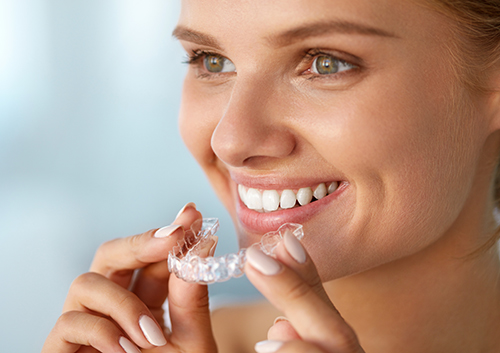
You may have a talent for home repairs. You may be able to rebuild your computer. You may even be able to put together a whole room of furniture armed only with flat-box kits and an Allen wrench. But, please—don’t try do-it-yourself orthodontics!
Now that generic clear aligners are available, you might consider giving them a try to save some money. But is straightening your own teeth really a good idea? Before you are tempted, let’s look more closely at the products and the dental science involved.
Invisalign®
- Invisalign clear aligners are used by orthodontists and dentists with experience in custom treatment for your smile. A 3D image of your teeth will be captured by the iTero Element® scanner. Using special software, your doctor can map out each projected shift in your teeth, and even show you a projection of your finished smile!
- Your Invisalign aligners will be tailored to fit your teeth precisely using the 3D scan and 3D printing. They are made from SmartTrack® material, a product specifically engineered for a perfect, comfortable fit. Invisalign aligners are even trimmed to fit your individual gumline to prevent irritation.
- When your first sets of Invisalign aligners arrive at our Romeoville, IL office, Drs. Angela Paros, Amer Atassi, Eric Young, Alexander Katsnelson will check for fit, answer any questions you might have about use and care, and let you know what to look for and what to expect. Your progress will be monitored with visits every six to eight weeks. (And for parents of teens, Invisalign aligners can offer blue “compliance indicators” to let you know they are being worn the 20-22 hours a day necessary for the best and fastest results.)
Generic Aligners
- You might be required to make a putty mold of your own upper and lower teeth, which is not the easiest thing to do well, and to take selfies of your teeth.
- The aligners will be sent to you in the mail. They are generally made of hard plastic with generic gumlines. There will be no one to tell you if the aligners fit properly.
- They are sometimes less expensive because there is no in-person medical supervision. A dental professional working for the company will look at the model created from molds you submit, and recommend a series of aligners to correct the problems he detects by looking at the model and your selfies. This supervisor will not be able to assess the overall dental health of each patient to make sure teeth and gums are healthy and ready to start treatment, and will not be able to tell if the teeth are moving properly or improperly once the aligners are in use.
Finally, while generic aligners may potentially have some success in minor tooth straightening, they are not created to deal with complex bite issues or malocclusions. In fact, using generic aligners with no supervision can cause more serious dental problems than a patient started with.
Sure, sometimes a do-it-yourself project turns out well. But your teeth and bones are too important for home improvement. When it comes to creating a beautiful, even smile and balanced, comfortable bite while making sure of your dental health, it’s always best to trust a professional like Drs. Angela Paros, Amer Atassi, Eric Young, Alexander Katsnelson to provide you with gentle, tested, and successful care!
Can my body reject my dental implant?
January 20th, 2021

According to the International Congress of Oral Implantologists it is rare that your body will reject your dental implants. However, this does not mean that your dental implant will not fail. A successful dental implant is one that is placed in healthy bone and is properly cared for after the surgery takes place.
There is only one major reason why a dental implant would be rejected: a titanium allergy. The majority of dental implants are made with titanium because it has proven to be the most biologically compatible of all metals. On average, less than one percent of potential dental implant recipients reported an allergy to titanium.
Dental Implant Failure
The most common cause of dental implant failure in the upper and lower jaw is bacteria. Everyone has bacteria in their mouth. If you have bacteria in your jawbone at the time of your dental implant, it can spread from implant to implant, causing dental implant failure.
If you do not take proper care of your dental implants, that could also cause them to fail. You also have to take proper care of the implant and keep your mouth clean. The development of excessive bacteria around the implant and in surrounding tissues can lead to implant failure.
Teeth grinding is another reason dental implants fail. When you grind your teeth, it can move the implants out of position. Therefore, you should wear a mouthpiece when you go to sleep if you know you grind or clench.
If you take care of your implants by practicing good oral hygiene and visit our Romeoville, IL office, you should not have any problems with your new dental implants. As always, ask Drs. Angela Paros, Amer Atassi, Eric Young, Alexander Katsnelson about any questions or concerns you have about you dental implants.
