

Five Things You Didn't Know About Cavities
July 2nd, 2019

Most people know when they have a cavity—they can either see it on their tooth or... ouch! They can feel it! But there are certain things that many of our patients don't know about cavities that could save them a trip to our Romeoville, IL office!
1. Not all sugars are created equal
It's quite well known that eating dietary sugars in excess along with poor oral hygiene leads to dental decay such as cavities. This is due to the fact that the bacteria in your mouth feed on these sugars and excrete acids as a byproduct of that process, thus causing decay. But xylitol, a sugar alcohol derived from birch or corn, actually prevents the bacteria from converting sugars into acids.
Xylitol is available in the form of gum, mints, toothpaste, and even in a granulated form much like regular cane sugar. You might consider trying some xylitol products between meals to keep your mouth clean and fresh.
2. It's not always what you eat but HOW you eat
Are you a grazer, always snacking between meals and never satisfied? We now know that this kind of eating can contribute to cavities and other oral health problems.
Every time you eat anything with carbohydrates in it, you're feeding the bacteria in your mouth, which in turn produce acids. If you're constantly eating, it doesn't allow your saliva time to bring the pH of your mouth back into a more alkaline, neutral state. It takes your saliva about 20 minutes to neutralize the acids in your mouth after eating.
It's especially easy to harm your teeth in this way with soft drinks, sipping all day long. So, it's best to avoid sugary drinks and junk food, and if you need a snack opt for healthy vegetables or what are known as "detergent foods." If you do decide to drink a soft drink or eat something sugary, have it all at once and not over the course of the day.
3. Flossing is one of the most important oral hygiene techniques
Although most of our patients are aware that they need to brush, sometimes they can get lackadaisical when it comes to flossing. And that's a big mistake. Flossing is one of the most important (and we daresay, easiest) things someone can do to help prevent cavities and tooth decay.
You see, as we've already mentioned, the bacteria in your mouth that cause cavities feed on the food you eat. So if you've got pieces of that food stuck between your teeth all day and night, every day, that's asking for a problem.
Flossing clears that bacteria-feeding food out from between your teeth. Floss daily and whenever you decide to do it, morning or night, just do it!
4. A dry mouth can lead to cavities and tooth decay
Your teeth's best defense against cavities and tooth decay is actually your saliva! We've already talked about the pH neutralizing effect saliva has. So if you find you have a dry mouth often, make sure to have some water to sip on. Or why not try some xylitol mints or gum to get your saliva production kicked into action?
5. Over-brushing can damage your enamel
If you brush like a construction worker with a jackhammer, you should ease up! Brushing too hard can scrape away at your teeth's enamel, which leaves them more susceptible to cavities and decay. Brush lightly, with your brush angled at the gum line for two minutes, twice a day. That's all that is required!
Make Brushing With Your Child Fun!
June 25th, 2019
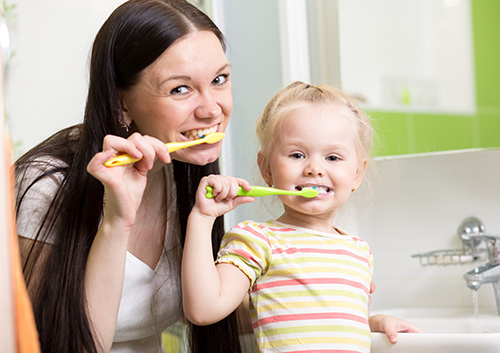
It’s no secret that kids and adults have different priorities: your duty is to raise a happy, healthy child, but your little one’s only priority may be to have fun. When it comes to brushing teeth, it can be hard to combine a healthy habit with having fun. You might fear it can’t be done, but with a little creativity, brushing time can be a great experience for both of you!
Make It a Party
Brushing time doesn’t have to be a chore when you throw a little party! Get Mom and Dad together so the whole family can brush their teeth at the same time.
Let your child choose a song to dance to while you all brush for the required two minutes. Your son or daughter may grow to love this silly routine, especially when the parents are clearly dedicated to brushing their own teeth as well.
Big Kid Decisions
Kids love the responsibility of making “big kid” decisions. Keep a variety of toothbrushes, colors of floss, and toothpaste flavors on hand so they can choose something “new” each time they brush, just like when they visit our Romeoville, IL office.
Not only can this help them grow more comfortable with the idea of seeing the dentist, but they’ll love having the responsibility of picking what would be fun at brush time.
Practice Makes Perfect
It’s true that the only way to get better at something is to practice, practice, and practice. Have your child practice brushing on his or her favorite stuffed animal, and use that opportunity to teach your youngster how to hold the brush and use circular cleaning motions. Showing how you brush your own teeth can also be worthwhile.
There’s An App For That
Did you know there are lots of fun apps that encourage good brushing habits among children? Brands like Oral-B and Aquafresh have free apps you can download on your phone.
The child gets to select a character, scenery, and a song he or she would love to accompany the task of brushing. If you have a daughter, she might like to use the Tooth Fairy Timer, which allows her to pick her very own fairy as her brushing buddy.
The important things to remember when you seek to establish good brushing habits is to keep it fun and stay consistent with your routine. It may take some getting used to, but after a while your child will become familiar with brushing and might even look forward to the new dental routine.
Nitrous Oxide Sedation
June 18th, 2019

Some patients may require nitrous oxide to remove pain or anxiety during dental treatments. If you desire any form of dental treatment at our Romeoville, IL office, Drs. Angela Paros, Amer Atassi, Eric Young, Alexander Katsnelson may administer nitrous oxide for its anesthetic/analgesic properties.
Commonly known as laughing gas, nitrous oxide is a gaseous sedative that’s inhaled through a mask over the nose. It was first used in the mid 1800s when practitioners didn’t know they should mix oxygen with the nitrous oxide, which wasn’t healthy alone.
These days, nitrous oxide is administered with at least a 30% oxygen mix, which makes it safe for any dental care.
Some of the effects you may experience while you’re sedated include:
- Lightheadedness, and tingling in the arms and legs, followed by a warm or comforting sensation
- A euphoric feeling or a sensation that you are floating
- Inability to keep your eyes open, so it feels as if you’re asleep
The percentage of nitrous oxide can be easily adjusted if necessary. Let Drs. Angela Paros, Amer Atassi, Eric Young, Alexander Katsnelson know right away if you feel uncomfortable or sick. The effects wear off quickly after you begin to breathe regular air following your treatment.
If you still have concerns about nitrous oxide, feel free to call our office about it. Our staff can go over other options for sedation and select the best one for you.
My child has canker sores! How can I help?
June 11th, 2019

According to the American Association of Pediatric Density, roughly one in five children suffers from canker sores. Canker sores are small sores that appear inside the cheeks, on the lips, on the surface of the gums, and under the tongue.
Even though, canker sores are not contagious, they do tend to run in families. There are several reasons your child may be suffering from canker sores including:
- Children who have Vitamin B12, iron, and folic acid deficiencies tend to get canker sores more often than children who have normal levels of these vitamins and minerals.
- Children who suffer from food allergies are also at a higher risk for developing canker sores. It’s difficult to determine what your child may be allergic to. If you feel strongly that the canker sores are related to an allergy, then a visit to an allergist is highly recommended.
- Biting their lip or cheek can also result in a canker sore.
- Any injury to mouth, where the skin breaks can cause a canker sore.
- Brushing their teeth too hard can also be a problem.
- Your child may be sensitive to an ingredient in their toothpaste. Try switching toothpastes and see if it makes a difference.
- Emotional disturbances and stress are also factors to consider.
If your child has frequent canker sores a visit to our Romeoville, IL office will be beneficial. Canker sores are painful and usually last about 14 days. Drs. Angela Paros, Amer Atassi, Eric Young, Alexander Katsnelson may recommend one or a few of the following treatment options:
- Avoid food that is acidic, salty, and spicy.
- A toothbrush with soft bristles may be helpful.
- Avoid mouthwash and toothpaste that contain SLS.
- Do not feed your child foods that they may be allergic to.
Canker Sore Remedies
- Eating yogurt that contains Acidophilus will relieve the pain and help the canker sore heal faster.
- Put one teaspoon of baking soda in an eight-ounce glass of lukewarm water. Have your child gargle and swish it around his or her mouth several times a day. Not only does this remedy relieve the pain, the canker sore could be gone in as little as 24 hours.
- Place a wet tea bag on the sore and hold it there for a few minutes several times a day. This remedy will help with the pain and quickly heal the sore.
- Camphor, Benzocaine, Lidocaine, and Orajel are over-the-counter medications that can help.
If you have questions about your child’s canker sore, contact Drs. Angela Paros, Amer Atassi, Eric Young, Alexander Katsnelson to schedule an appointment.
