


I don't brush while I'm at work. Should I?
March 31st, 2015
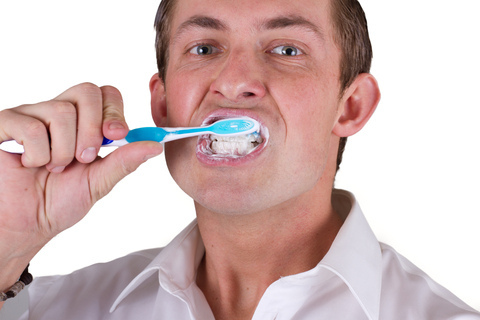
Yes, absolutely. A recent survey by Oral-B® reveals that despite knowing that a healthy, good-looking smile affects not only their personal wellness but their professional image as well, very few people (only 14 percent) brush and floss at the office regularly. What’s more, three quarters of people who responded to the survey said they ate twice or more a day at work.
Today, Dr. Angela Paros, Dr. Anthony Reganato and Dr. Matthew Hamedani and our team thought we would provide some tips for brushing at work.
- Leave a toothbrush at work to increase your likelihood of brushing
- Brush your teeth twice a day with fluoride toothpaste. Replace your toothbrush every three or four months, or sooner if the bristles are frayed. A worn toothbrush won’t do a good job of cleaning your teeth.
- Clean between teeth daily with floss or an interdental cleaner; this helps remove plaque and food particles from between the teeth and under the gum line. Tooth decay-causing bacteria still linger between teeth where your toothbrush bristles can’t reach.
And remember to brush for 30 to 45 seconds across visible parts of the teeth. Brushing after breakfast or lunch will eliminate any remaining food particles and odors. We recommend people brush their teeth twice and floss once a day to remove plaque and other harmful bacteria.
To schedule your next appointment with Dr. Angela Paros, Dr. Anthony Reganato and Dr. Matthew Hamedani at our Romeoville, IL office, please give us a call!
Four Oral Health Issues Seniors Face
March 24th, 2015

Oral health is an important and often overlooked component of an older person’s general health and well-being. Dr. Angela Paros, Dr. Anthony Reganato and Dr. Matthew Hamedani and our team know that for many of our older patients, oral health can become an issue when arthritis or other neurological problems render them unable to brush or floss their teeth as effectively as they once did. Today, we thought we would discuss four common oral health issues our older patients face and how they can avoid them:
Cavities: It’s not just children who get tooth decay—oral decay is a common disease in people 65 and older. Ninety-two percent of seniors 65 and older have had dental caries in their permanent teeth, according to the National Institute of Dental and Craniofacial Research. The risk for tooth decay increases because many older adults don’t go to the dentist as often as they used to, thus cavities go undetected and untreated for longer than they should. Keeping regular appointments with Dr. Angela Paros, Dr. Anthony Reganato and Dr. Matthew Hamedani is the key to getting cavities treated in a timely manner.
Difficulty eating: Oral health problems, whether from missing teeth, cavities, dentures that don’t fit, gum disease, or infection, can cause difficulty eating and can force people to adjust the quality, consistency, and balance of their diet.
Dry mouth: Also called xerostomia, dry mouth is a common issue for a lot of seniors. Our friends at the Oral Cancer Foundation estimate that 20 percent of elderly people suffer from dry mouth, which means the reduced flow of saliva (saliva plays a crucial role in preventing tooth decay). Many seniors are on multiple medications for a variety of chronic illnesses or conditions. Common medications taken that may cause dry mouth are decongestants, antihistamines, blood pressure medications, pain pills, incontinence medications, antidepressants, diuretics, muscle relaxers, and Parkinson’s disease medications. To help counter this, we suggest drinking lots of fluids and limiting your intake of caffeine and alcohol. We also encourage you to check with Dr. Angela Paros, Dr. Anthony Reganato and Dr. Matthew Hamedani during your next visit if you think your medications are causing your mouth to feel dry.
Gum Disease: Gum (periodontal) disease is an infection of the gums and surrounding tissues that hold teeth in place. While gum disease affects people of all ages, it typically becomes worse as people age. In its early stages, gum disease is painless, and most people have no idea that they have it. In more advanced cases, however, gum disease can cause sore gums and pain when chewing.
Gum disease, which can range from simple gum inflammation to serious disease, is usually caused by poor brushing and flossing habits that allow dental plaque to build up on the teeth. Plaque that is not removed can harden and form tartar that brushing simply does not clean. Only a professional cleaning at our office can remove tartar. The two forms of gum disease are gingivitis and periodontitis. In gingivitis, the gums become red, swollen, and can bleed easily; in periodontitis, gums pull away from the teeth and form spaces that become infected.
Proper brushing, flossing, and visiting our office regularly can prevent gum disease. Seniors with limited dexterity who have trouble gripping a toothbrush should ask Dr. Angela Paros, Dr. Anthony Reganato and Dr. Matthew Hamedani about modifying a handle for easier use or switching to a battery-powered toothbrush.
St. Patrick's Day
March 17th, 2015

On March 17, everyone has a little Irish in them. St. Patrick’s Day is a joyous celebration of Irish heritage. The holiday originated as a commemoration of Saint Patrick, who brought Christianity to Ireland. The saint arrived in Ireland in 432 and earned the reputation of a champion of Irish Christianity. March 17th, the day of St. Patrick’s death, has been commemorated by the Irish for over 1,000 years. St. Patrick’s Day is still observed as a religious feast day by several Christian denominations, but it is better known in the public imagination as a rich celebration of Irish culture.
St. Patrick’s Day has been an official public holiday in Ireland since 1903. Each year, the Irish celebrate with a several-day festival that includes theater performances, music, fireworks, and festive parades. The celebration is also a public holiday in Northern Ireland, Montserrat, and Newfoundland and Labrador. In other parts of the world with heavy Irish populations, it is an unofficial celebration of Irish heritage. Parts of Great Britain, Canada, Argentina, South Korea, Switzerland, New Zealand, the United States, and Australia commemorate the holiday each year. Typical celebrations in these countries include drinking green beer, wearing green, eating traditional Irish foods, parades, and shamrock decorations.
Many people, Irish and non-Irish alike, take part in the “wearing of the green” on St. Patrick’s Day. In fact, the color originally associated with Saint Patrick was blue. His use of shamrocks to explain the Holy Trinity to the Irish made the green clover emblematic of the holiday, leading to the traditional green attire worn by thousands on St. Patrick’s Day. Other little-known facts about St. Patrick’s Day include the following:
- Each year, the United States and Ireland face off in a rugby competition called the “St. Patrick’s Day Test.”
- Montreal celebrates the holiday with an annual parade, which has been held each year since 1824. The Montreal city flag even features a shamrock in its corner, as a nod to its Irish heritage.
- The Guinness World Records named St. Patrick’s Day the “Friendliest Day of the Year.”
- Along with Valentine’s Day, St. Patrick’s Day is one of the most widely celebrated saint’s day in the world.
No matter your cultural heritage, St. Patrick’s Day is a great time to let loose and celebrate your inner Irish-ness! Don your greenest attire and exclaim “Erin go Bragh!” (Ireland forever!) to everyone you meet. From Dr. Angela Paros, Dr. Anthony Reganato and Dr. Matthew Hamedani - have a great St. Paddy’s day!
Why should I have my child’s wisdom teeth removed?
March 10th, 2015

The wisdom teeth are the last of the permanent molars to emerge from the gums. This can occur as early as age 17 or as late as 21. Though some teens and young adults experience a completely normal tooth eruption with ideally aligned molars that pose no health threat, this is not the case for everyone.
According to the American Association of Oral and Maxillofacial Surgeons (AAOMS), wisdom teeth must meet specific criteria to avoid a required extraction. These guidelines include:
- Completely erupted and non-impacted
- Completely functional
- Painless
- Free of decay
- Disease-free
- Capable of being properly cleaned
If one or more of your child’s wisdom teeth do not meet these conditions, we recommend scheduling an appointment with Dr. Angela Paros, Dr. Anthony Reganato and Dr. Matthew Hamedani; an extraction may be necessary.
Impacted wisdom teeth
One of the most common reasons for extracting a wisdom tooth is due to impaction. An impacted wisdom tooth is one that has not erupted and will not fully erupt from the gums. Usually this occurs because there is not enough room for the tooth to emerge. Impaction can be painful and can also lead to infection if left untreated. According to the AAOMS, roughly 90 percent of the teen and adult population has at least one impacted tooth. Extracting an impacted wisdom tooth early can help prevent future complications, such as periodontal disease, infections, and damage to neighboring teeth.
Extracting fully erupted wisdom teeth
Even if your child’s wisdom teeth are fully erupted, Dr. Angela Paros, Dr. Anthony Reganato and Dr. Matthew Hamedani and our team at High Point Dental Group may recommend removing them as a preventive measure. Fully-erupted third molars often interfere with a healthy bite. This can lead to problems with tooth and jaw alignment and may also contribute to the development of headaches. Your child’s wisdom teeth may also be more prone to tooth decay and gum disease, because their location in the back of the mouth makes them more difficult to reach for brushing and flossing.
To learn more about wisdom teeth, or to schedule an appointment with Dr. Angela Paros, Dr. Anthony Reganato and Dr. Matthew Hamedani, please give us a call at our convenient Romeoville, IL office!
