


The Safety of Dental X-Rays
October 31st, 2017
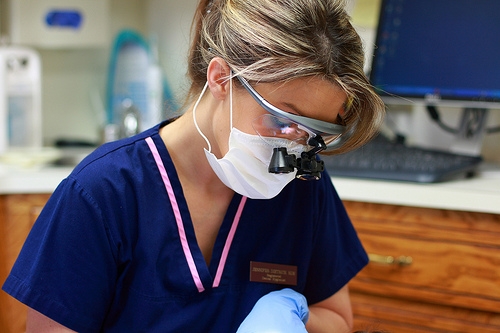
An article was released to the public stating that dental X-rays contribute to a type of brain cancer. After reading an article like this, your first thought may be to avoid dental X-rays, but you may want to hold off on that quick judgment. As with any treatment we offer at High Point Dental Group, education is your most valuable tool in deciding what is best for you.
How often dental X-rays are taken is based on risk for infection, physical symptoms, and clinical findings. The American Dental Association (ADA) is a governing body over the dental profession. The ADA states, “ . . . healthy adults receive routine mouth X-rays every two to three years. Dental X-rays are recommended every one to two years for children and every 1.5 to three years for teens. Children often require more X-rays than adults because of their developing teeth and jaws and increased likelihood for cavities.”
A "caries risk category" often determines how often dental X-rays are taken. The most recent documented resource to determine a caries risk is Caries Management by Risk Assessment (CAMBRA). This was adopted by the ADA and is used by dental professionals giving interval recommendations for X-rays.
With knowledge of your risk for dental infection, you will be informed by Drs. Angela Paros, Amer Atassi, Eric Young, Alexander Katsnelson of the interval at which dental X-rays should be taken. You can rest assured that the standards published by the ADA have been researched extensively and are there to protect your personal health and safety.
Dental X-rays are most commonly digital, which significantly reduces exposure. There is more radiation exposure from the sun or in an airplane than in a dental X-ray. It is common practice to use a lead apron with a thyroid collar for protection during X-ray exposure.
Having a cavity means having an active, potentially harmful infection. Diagnosing such infection with minimal exposure through digital dental X-rays at our Romeoville, IL office does more good than harm.
What exactly is a root canal?
October 24th, 2017

Hearing that you need a root canal can be highly intimidating. What is a root canal? It is the removal of the nerve supply from the tooth. Here, Drs. Angela Paros, Amer Atassi, Eric Young, Alexander Katsnelson will describe the parts of a tooth and explain the reasons for a root canal and how it is done when you visit us in our Romeoville, IL office.
Your tooth is made up of many layers. The outside layer is called enamel and is made of minerals. The middle layer is dentin, which is also a calcified tissue, but less dense. The center of the tooth is called the pulp, and that hosts the nerves and blood vessels. A root canal is the removal and replacement of this center with a sterile filling.
A root canal is needed when an infection spreads to the center of the tooth. This can be from trauma (recent or previous), a cavity, a severe crack, or other compromise that causes nerve damage. An X-ray and examination are required to see if a root canal is needed. Symptoms may include but are not limited to pain, swelling, change in tooth color, and over-reaction to temperature change or pressure.
When it is time to begin, you’ll receive local anesthesia (via injection) to make you most comfortable. A rubber dam is used to isolate the tooth, while other equipment determines the nerve location and maintains a sterile working environment. All of the infected area is removed including the nerve tissue and blood vessels. Then, medicines are used to sterilize and alleviate any pain. Next is the placement of a filling material in the spot where the nerve used to be.
When your nerve and blood supply are taken away, the tooth is non-vital, or dead, and can become weak and fragile. If your tooth is badly decayed, a large portion of it will have to be removed. It is recommended to place a crown on the tooth to keep the enamel from breaking or falling apart. If you do not get a crown, you could eventually lose the tooth to more decay or infection. The tooth could also break off completely and you would have to have an extraction. The crown fits over the top of the tooth and secures it from breaking down.
A root canal saves the life of a tooth that would otherwise succumb to further infection and eventually extraction. Infection is the cause of most-needed root canals. If you are ever unsure what is happening at your appointment, don’t be afraid to ask questions so you understand the procedure completely.
Root Canal FAQs
October 17th, 2017

Most people hear the word root canal and panic. With today’s state of the art equipment and improved local anesthetic devices, and some knowledge, a root canal does not have to cause panic. Root canals are a common dental procedure, done quite often at our Romeoville, IL office.
Why do I need a root canal?
There are several reasons why Drs. Angela Paros, Amer Atassi, Eric Young, Alexander Katsnelson may suggest a root canal including:
- An infection in your tooth that has reached the nerves
- A deep cavity that cannot be filled because the pulp and nerves are also effected
- Injury to the tooth
- A deep cracked tooth
- Broken tooth
- Repeated fillings of the effective tooth
What is a root canal?
A root canal is a dental procedure that is used to prevent the loss of a tooth and relieve pain. Inside your teeth is pulp which consists of soft tissue blood, connective tissue, blood vessels, and nerves. When the pulp becomes infected, swollen or diseased a root canal is necessary to save your tooth. During a root canal, Drs. Angela Paros, Amer Atassi, Eric Young, Alexander Katsnelson will remove the infected pulp. The tooth’s root canals and pulp chamber of your tooth will be cleaned, so all the diseased pulp is removed and then your tooth will be sealed.
What to Expect During a Root Canal
Your root canal will start out just like any other dental procedure. We will go over any questions you may have, and then numb the area surrounding the tooth. After the area is numb the root canal will begin.
The amount of time it takes to do your root canal varies depending on number of roots that need to be cleaned. Most teeth have one root canal, while others have between two and four. For a single canal, the procedure usually lasts less than an hour. The more canals your tooth has the longer amount of time it will take and in some cases, you will require more than one visit.
How much pain will I have after a root canal?
Once the local anesthesia wears off, your pain can be controlled by over the counter pain medications such as Ibuprofen, Naproxen, or Acetaminophen. In some cases, Drs. Angela Paros, Amer Atassi, Eric Young, Alexander Katsnelson may prescribe a prescription dose of pain medication. Within two days you should be feeling much better and able to return to your regular lifestyle.
What to do about Sensitive Teeth
October 10th, 2017

If you suffer from sensitive teeth, you already know the frustration of having a type of pain that is hard to deal with. Because tooth sensitivity is sometimes unpredictable, you can't necessarily take medication to ward off the pain like you could if you just felt a headache coming on.
However, there is still something you can do about sensitive teeth. Use the following tips to help put your sensitivity and pain problems with your teeth behind you!
Use the Right Toothbrush: Select a toothbrush made just for sensitive teeth, or the softest bristles possible. This helps you avoid putting any extra pressure on your teeth or gums.
Choose a Special Toothpaste: There are several good options for toothpastes made just for sensitive teeth today. Usually, toothpaste formulated for sensitive teeth will be fluoridated and use a non-abrasive formula. The toothpaste will help with the pain usually associated with brushing and flossing if you use it regularly.
Avoid Trigger Foods: You may have noticed certain trigger foods that cause tooth sensitivity and pain for you. Avoid these foods whenever possible, and if you absolutely must eat them, try to consume them in very small quantities. Trigger foods may include:
- Foods with high acid content for example citrus fruits
- Very hot or very cold foods
- Hard or crunchy foods
Visit Our Office
If your sensitive teeth problem is too serious to manage on your own, a visit to our Romeoville, IL office may be in order. There are a couple of ways Drs. Angela Paros, Amer Atassi, Eric Young, Alexander Katsnelson can help:
- Fluoride Treatments: We can put a special fluoride formula on the most sensitive areas to help make your enamel stronger and to help lower pain levels.
- Sealing Exposed Roots:In some cases, your roots become exposed due to a receding gumline, which in turn causes teeth sensitivity and pain. We can apply a dental sealant that protects the exposed roots and reduces your pain dramatically.
